A mislabeled blood tube can send the wrong result to the wrong patient. In a busy Indian hospital lab processing 300 to 500 samples a day, the risk is real and the consequences serious. Lab sample barcoding through a unique Specimen ID links every tube to the correct patient, test order, and collector before the sample leaves the collection point.
How do labs prevent sample mix-ups? Labs prevent sample mix-ups by assigning a unique SID (Specimen Identification Number) as a printed barcode to every sample at the point of collection. The barcode links the tube to the patient, the collector, and the timestamp. Every scan at processing, analysis, and reporting confirms identity before any result is recorded.
Why Sample Mix-Ups Happen in Indian Labs
In a typical 100-bed hospital, the lab receives samples from the OPD collection room, inpatient wards, the ICU, and sometimes an external collection center. Each handoff is a failure point. High volumes during morning OPD peak hours, staff fatigue on night shifts, and similar-looking tubes sitting side by side in a collection tray are the everyday conditions under which errors occur.
Common causes of sample mix-ups in Indian hospital labs:
- Hand-written labels that smudge, fade, or are misread under time pressure
- Name confusion when two patients share the same surname or similar demographics
- Batch collection in the ICU where tubes from different patients travel in the same tray
- Shift changeovers where outgoing phlebotomist work is not formally handed over
- Manual result entry where a technician types into the wrong patient record
A single mix-up can trigger a wrong diagnosis, an unnecessary procedure, or a delayed TPA or Ayushman Bharat claim. Re-collecting a sample costs ₹150 to ₹400 in reagents and staff time, before accounting for patient dissatisfaction or potential medico-legal exposure.
What Is a SID Number and How Lab Sample Barcoding Works
A SID number (Specimen Identification Number) is a unique code generated by your Lab Information System the moment a test is ordered. It stays with that sample for its entire life in the lab. Printed as a barcode on an adhesive label, it removes every manual transcription step that currently creates risk in your workflow.
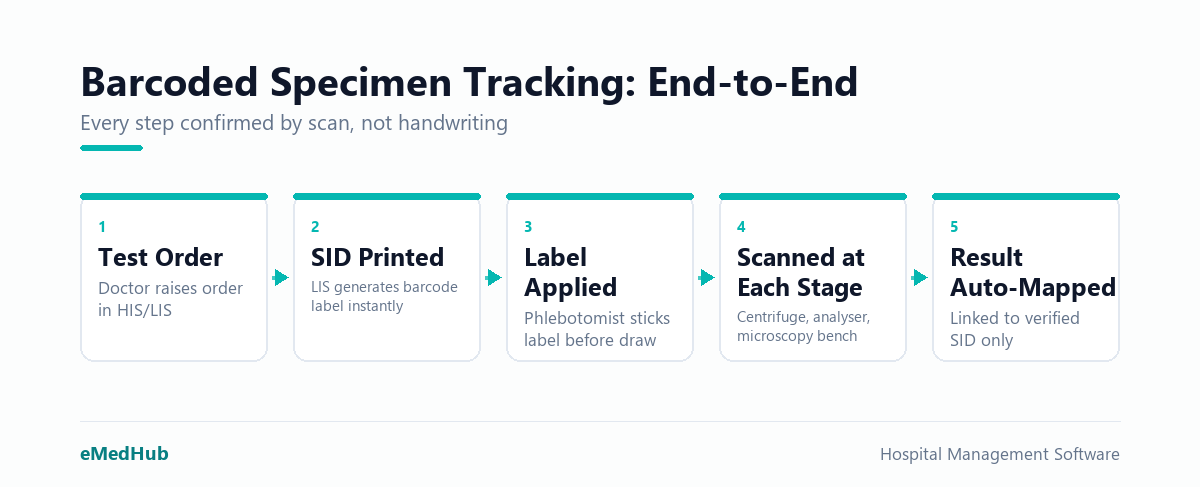
The barcoded specimen tracking process works in sequence:
- The doctor raises a test order in the HIS or LIS.
- The LIS generates a unique SID and sends a print job to the collection counter.
- The phlebotomist sticks the barcode label on the correct tube before collection begins.
- At every downstream step (centrifuge, analyser, microscopy bench), the technician scans the barcode.
- The analyser or LIS only maps a result against a verified SID. No scan, no result.
A barcode lab environment removes handwriting from the chain entirely. In a lab processing 400 samples daily, even a 0.5% manual error rate means two at-risk samples every day. With barcoded SIDs, that rate drops to near zero.
| Step | Manual Workflow | Barcoded SID Workflow |
|---|---|---|
| Label creation | Written by hand at collection | Printed by LIS before collection |
| Patient-sample link | Compared visually | Confirmed by scan |
| Processing handoff | Verbal or paper-based | Scan-logged chain of custody |
| Result entry | Typed manually | Auto-mapped to SID |
| Typical error rate | 0.3–1.0% | <0.05% |
| Audit trail | Paper register | Digital, timestamped |
Collector and Timestamp Logging
Knowing who collected a sample and when is as important as knowing which patient it belongs to. When your phlebotomist scans the printed barcode and logs their staff ID, the system records the collector name and employee number, the date and time to the minute, the collection point (OPD bay, Ward 3B, ICU bed 7), and the initial sample condition such as haemolysed or insufficient volume.
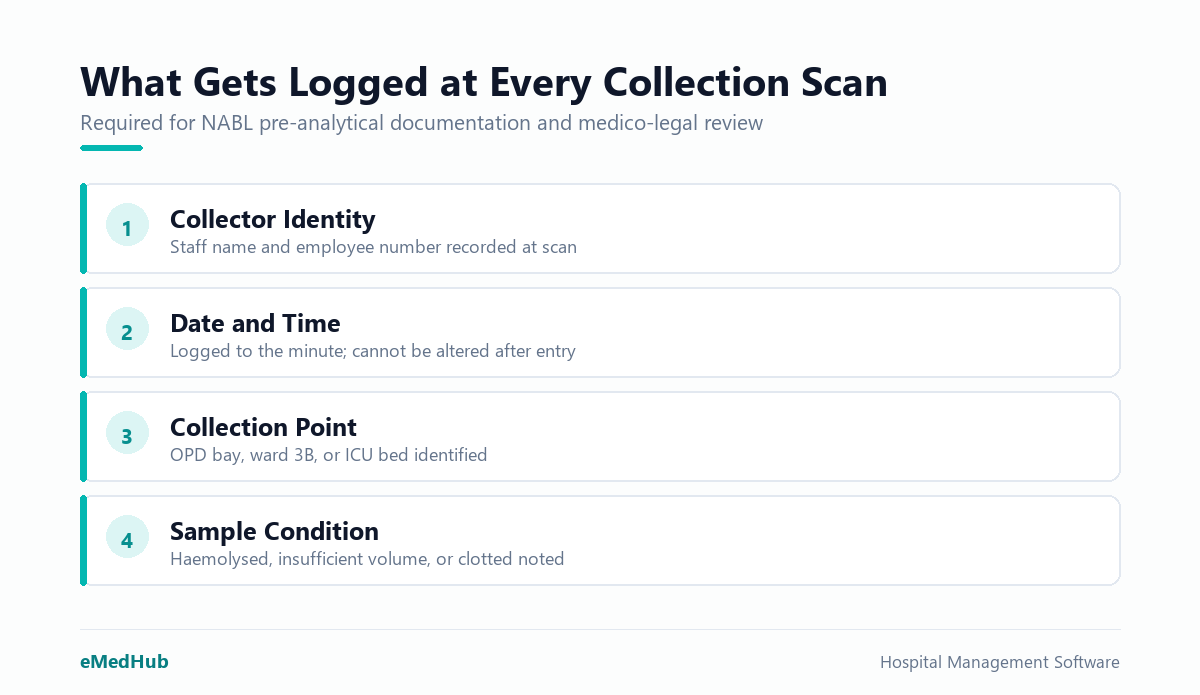
This chain-of-custody log matters for NABL accreditation, where pre-analytical documentation is a mandatory requirement. It also matters in medico-legal review: if a result is questioned, you can show exactly who handled the sample at every stage, with timestamps that cannot be altered after the fact.
For CGHS, ESI, or TPA audits, a digital collector log removes the need to search through paper registers. Your quality manager can pull a complete chain-of-custody report for any sample in under a minute, from any workstation.
Damage Revert: Protecting Data When a Sample Is Rejected
Not every sample reaches the analyser in usable condition. Haemolysis, insufficient volume, clotting in a coagulation tube, the wrong anticoagulant: these are routine rejection reasons. What happens to partially entered data matters as much as what happens to the physical sample.
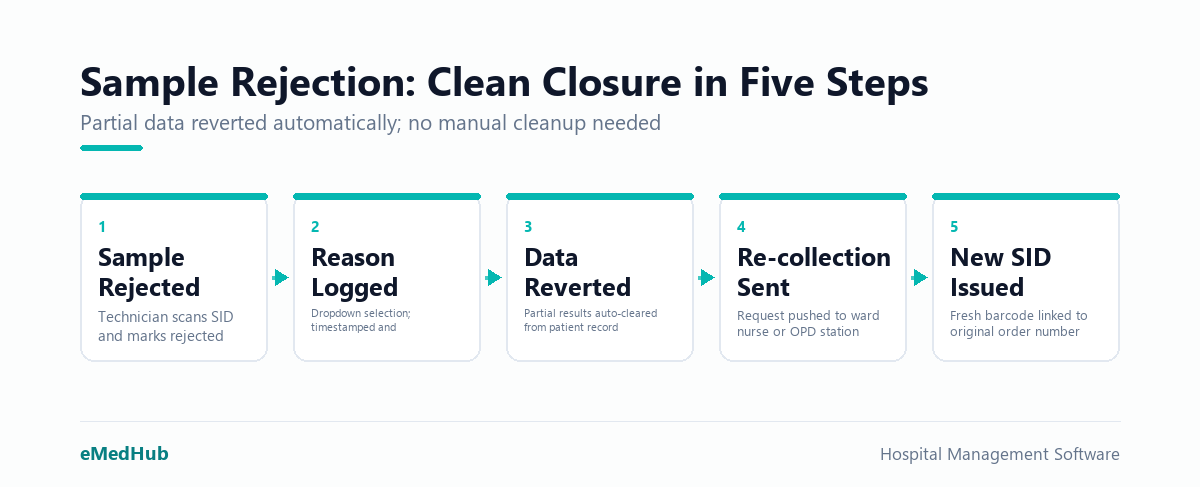
In a paper-based lab, rejection creates ambiguity. Was a partial result already entered? Does the ward know to send a fresh sample? A properly configured LIS with SID barcoding handles rejection cleanly:
- The technician scans the SID and marks the sample rejected, selecting a reason from a dropdown.
- The system auto-reverts any partial result entry tied to that SID. No wrong data reaches the treating doctor.
- A re-collection request is pushed automatically to the relevant ward nurse or OPD station.
- A new SID barcode is generated for the fresh sample, linked to the original order number.
- The rejection reason, timestamp, and staff ID are recorded permanently in the audit log.
For labs working toward NABL accreditation, this rejection log directly satisfies the pre-analytical non-conformance documentation requirement. Nothing needs to be reconstructed from memory or paper at audit time.
Impact on Lab Turnaround Time
Specimen tracking through SID barcoding does more than prevent errors. It measurably shortens your lab's turnaround time. Every re-collection due to a mislabeled or misidentified sample adds 30 to 90 minutes to the result cycle. In an emergency, that delay affects a clinical decision. In routine OPD, it creates queues and frustrates patients who have already waited.
With a barcoded workflow, TAT improvements compound across the day:
- Eliminating mislabeling-related re-collections saves 30–90 minutes per incident avoided
- Automated result mapping removes manual data entry at the analyser interface
- Instant rejection alerts reach the ward within seconds, not after a phone call
- Parallel routing sends different test panels to different instruments without manual sorting
For a hospital processing 300 samples a day, avoiding one re-collection daily saves roughly 350 to 500 staff-hours a year. In tier-2 cities where the lab team runs four to six technicians across two shifts, those hours translate directly into additional throughput capacity.
Fast, accurate TAT also supports insurance claim processing. Ayushman Bharat and most TPA packages require lab results before a discharge summary is finalized. Reliable specimen tracking means discharge happens on schedule, and the bed turns over faster.
How eMedHub Handles SID Barcoding
eMedHub's diagnostic lab management software builds SID barcoding into the core order-to-result workflow, not as a bolt-on module. When a doctor raises a test order, the LIS generates the SID immediately and queues a label for printing at the collection counter. The phlebotomist scans the label at collection, logging their employee ID, the time, and the sample type. At the analyser, a bidirectional interface auto-maps results to the correct SID without manual entry.
If a sample is rejected, the damage-revert workflow runs automatically: partial entries roll back, a re-collection task is raised, and the audit log is updated in real time. Quality managers see a dashboard showing pending collections, rejection rates, and TAT performance by department. NABL and NABH pre-analytical non-conformance reports pull from the same log, so there is nothing to reconstruct at audit time.
For diagnostic chains with multiple collection centers, every location uses the same SID format. A sample collected at a satellite center carries its full chain of custody into the main lab's workflow, with no manual reconciliation needed.
To see the complete specimen tracking workflow in a live environment, request a demo with your lab team.
Frequently asked questions
What is a SID number in a lab?
A SID (Specimen Identification Number) is a unique code generated by a Lab Information System when a test is ordered. It is printed as a barcode on the sample tube label and links that specific sample to the patient, the test panel, the collector, and the collection timestamp throughout the entire lab workflow.
How does lab sample barcoding prevent mix-ups?
Lab sample barcoding attaches a unique printed ID to every tube before collection begins. At each processing step, the technician scans the barcode before the system accepts any result. This removes manual transcription and visual name comparison, eliminating the two most common causes of sample misidentification in high-volume Indian hospital labs.
Is barcode-based specimen tracking required for NABL accreditation?
NABL does not mandate barcoding explicitly, but it requires documented pre-analytical controls covering sample identification, collector logging, and non-conformance records for rejected samples. A barcoded SID system satisfies all these requirements automatically and produces the audit trail NABL assessors look for during an on-site assessment.
What happens to lab results when a sample is rejected?
With a properly configured LIS, rejecting a sample via its SID triggers an automatic data revert: any partial result entry rolls back, the treating doctor sees no incomplete data, and a re-collection request is sent to the ward. The rejection reason and timestamp are permanently recorded in the audit log.
How does specimen tracking improve lab turnaround time?
Every mislabeled or rejected sample requiring re-collection adds 30 to 90 minutes to the result cycle. Barcoded specimen tracking eliminates mislabeling at the source, automates result mapping at the analyser, and routes rejection alerts to the ward instantly. A lab processing 300 samples daily can recover 350 to 500 staff-hours a year from these savings.