Ask any hospital administrator whether their facility has a single patient record, and most will say yes. Ask someone who has spent an afternoon across registration, pharmacy, and billing at the same hospital, and you will hear a different story. The same patient appears as "Ramesh Kumar" in OPD, "R. Kumar" in IPD, and "Kumar Ramesh" in the pharmacy system. Three records, one person, guaranteed billing errors.
A unified patient record is a single, deduplicated longitudinal health record that follows a patient across every department, visit, and facility. You achieve it by assigning each patient a unique master identifier, merging duplicate entries through a structured deduplication process, and anchoring that identity to a verified national ID such as an ABHA number.
Why Patient Records Fragment in the First Place
Fragmentation rarely starts with bad intentions. It starts with a busy OPD counter at 8 a.m., a registration clerk entering data without the patient's old card, and a HIS that does not enforce a search before creating a new file. Indian hospitals face additional complexity: patients travel across districts, visit the pharmacy separately from the OPD, get admitted under Ayushman Bharat one time and pay cash the next, and give a different phone number on each visit.
Common fragmentation triggers in Indian hospitals:
- Walk-in registration without checking existing records, especially at peak hours
- Name spelling variations: "Mohammed" vs "Mohammad" vs "Mohd"
- Multiple phone numbers recorded across different visits and years
- Different payer episodes: once under CGHS, once under ESI, once self-pay
- Separate LIS or radiology systems that maintain their own patient ID numbering
- Paper-to-digital migration that imported records without any matching logic applied
The downstream cost is not just clinical. A 150-bed hospital processing ₹3 crore in monthly billing can lose ₹15–45 lakh a year to duplicate-driven claim rejections, missed prior authorisations, and misattributed pharmacy charges. Typically 5–15% of revenue is at risk when patient identity is poorly governed.
The Patient Master Index: Your Single Source of Truth
The patient master index, or PMI, is the directory that assigns every patient one unique identifier and stores the demographic attributes used to match that patient across all encounters. It is not a clinical record. It is the index that makes clinical records findable and linkable across your entire facility.
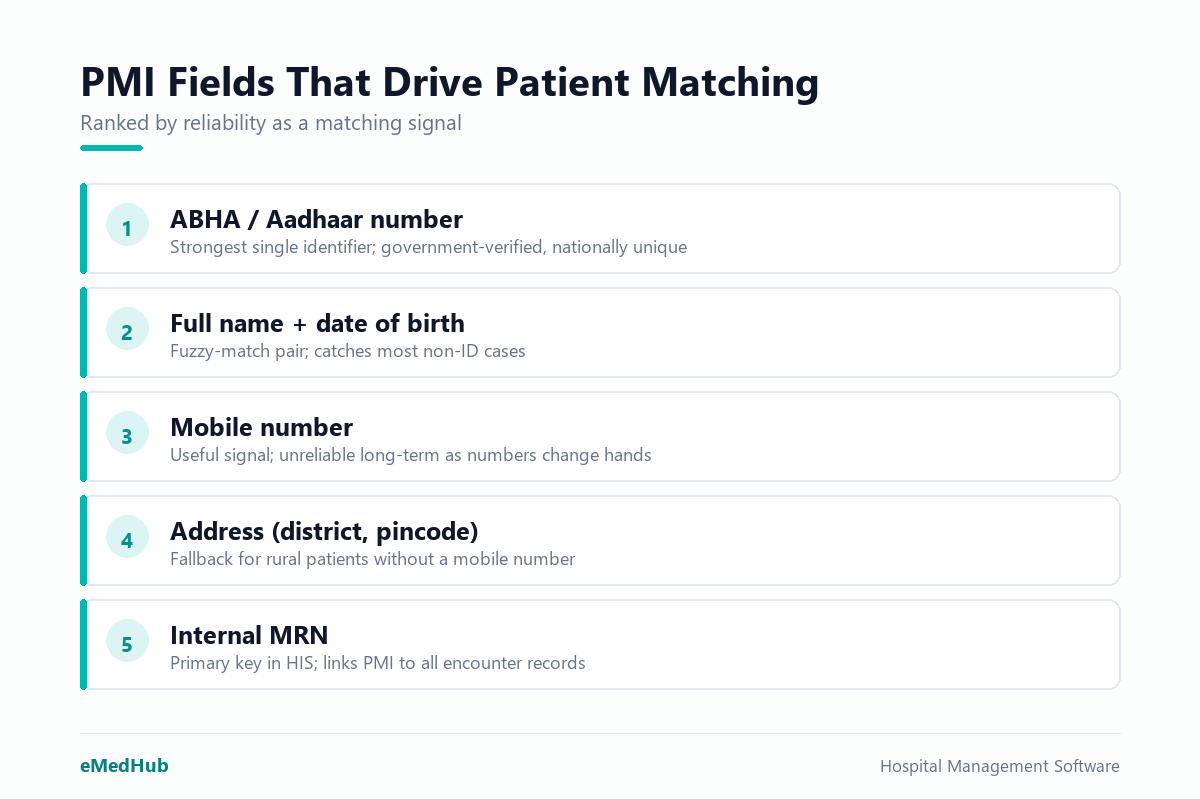
| PMI Field | Why It Matters for Matching |
|---|---|
| Full name (standardised case) | Base attribute for all fuzzy-match logic |
| Date of birth | High-discriminating when combined with name |
| Gender | Reduces false positive matches on common names |
| Mobile number | Reliable for urban patients; changes over time |
| Government ID (Aadhaar or ABHA) | Strongest single identifier available |
| Address (district and pincode) | Useful for rural patients without a mobile number |
| MRN (your internal number) | Primary key in your HIS |
The PMI does not eliminate duplicates by itself. It gives you the structure to detect and act on them. Without a governed PMI, every department becomes its own silo, and the single patient record remains aspirational rather than operational.
Deduplication: Where the Real Work Lives
Deduplication is the process of identifying records that belong to the same patient and merging them into one. It sounds straightforward. In practice, it is the most technically and politically complex part of building a unified record.
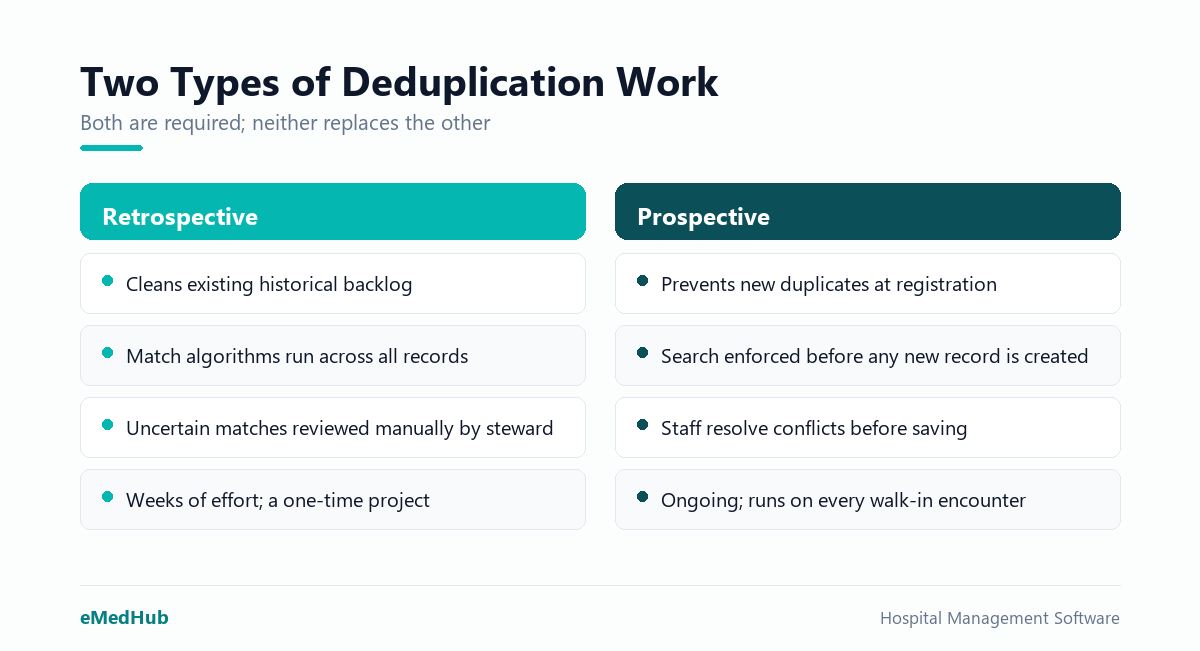
Your hospital needs two distinct types of deduplication work:
- Retrospective deduplication: Cleaning existing data. A hospital that has operated for ten years may hold 40,000 patient records for 28,000 actual patients. Running match algorithms against that backlog takes weeks, and a data steward must review uncertain matches manually before any merge is committed.
- Prospective deduplication: Preventing new duplicates at the point of registration. This means enforcing a patient search before any new record is created, using probabilistic matching on name and date of birth, and surfacing potential duplicates for staff to resolve before saving.
Matching logic typically combines exact and fuzzy rules. Exact match on Aadhaar or ABHA is the most reliable signal. Fuzzy match on name plus date of birth catches most remaining cases. Mobile number alone is unreliable: numbers change hands and get reused across subscribers.
Political friction matters just as much as the algorithm. Merging records collapses visit histories, billing ledgers, and insurance claim references. The radiology department may have linked its PACS to its own patient IDs. The LIS may export results keyed to its own numbering scheme. Getting department heads to accept a single master record requires governance, not just software.
ABHA as a National Anchor for Patient Identity
India's Ayushman Bharat Digital Mission gives every citizen the option to create an ABHA number, a 14-digit unique health identifier. Linking your internal MRN to a patient's ABHA number is the most reliable long-term identity anchor available to Indian hospitals today.
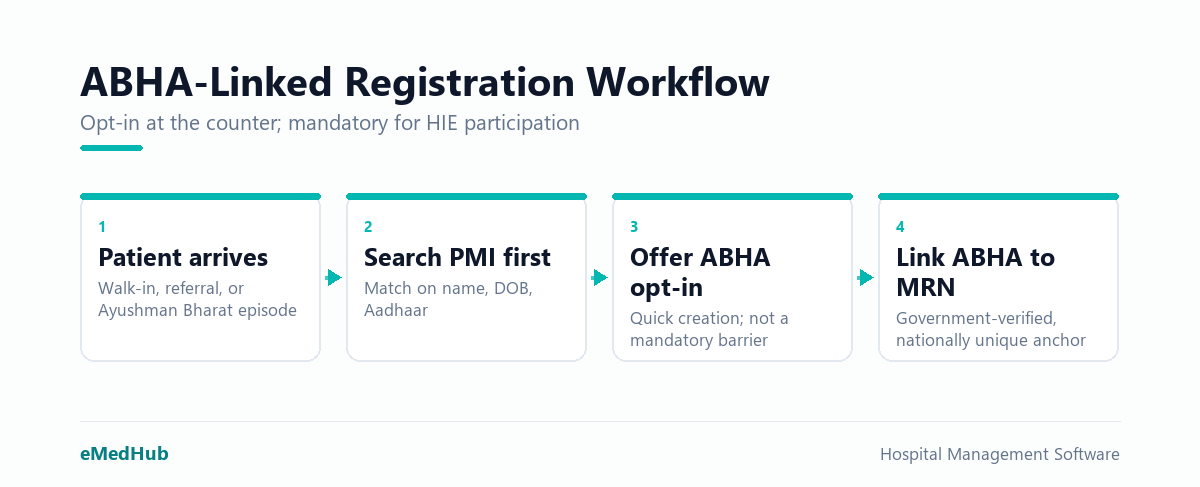
Here is what ABHA changes for your facility:
- It is government-verified, tied to Aadhaar, and nationally unique across the country
- A patient who moves from Jaipur to Bengaluru can be recognised at your facility without a paper card
- ABHA-linked records can participate in the Health Information Exchange network, pulling prior discharge summaries and lab reports from other ABDM-compliant facilities
- TPA and Ayushman Bharat claim workflows that reference ABHA face fewer rejections caused by patient identity mismatch
The practical challenge is adoption. Not every patient, particularly in tier-2 and tier-3 cities or among older age groups, will arrive with an ABHA number. Your registration workflow should offer ABHA creation as a quick opt-in step, not a mandatory barrier. Over time, the proportion of ABHA-linked records in your PMI becomes your single best measure of identity data quality.
Data Governance: The Part Nobody Wants to Own
Technology solves roughly 60% of the unified record problem. The remaining 40% is governance: who owns data quality, what rules apply at registration, and what happens when a duplicate is found. Without clear ownership, even the best HIS accumulates duplicates year after year.
A practical governance structure for a 50 to 200-bed hospital:
- Data steward: One named person, usually the MRD in-charge, with authority to merge records, resolve disputes, and report duplicate rates to hospital management each month
- Registration SOP: A mandatory patient search before any new registration is created, with a supervisor override required to bypass it
- Duplicate KPI: Track and review the duplicate rate (duplicates found divided by total active records) as a monthly metric alongside financial and clinical indicators
- Merge audit trail: Every merge action is logged with the responsible user, timestamp, and stated reason, so it can be reversed if the match turns out to be incorrect
Software can surface alerts. Only a person with clear accountability will act on them consistently. Governance is what turns a patient master index from a database directory into a lasting institutional asset.
How eMedHub Handles the Unified Record Problem
eMedHub's electronic health records module is built around a central patient master index. Every registration desk, pharmacy counter, and billing station works from the same patient record. The system enforces a duplicate-check search before any new patient file is created, with configurable match thresholds across name, date of birth, and mobile number.
For ABDM compliance, eMedHub supports ABHA number capture and verification at registration, linking your internal MRN to the national identifier. Retrospective ABHA linking for existing records is available as a bulk workflow. The MRD dashboard flags duplicate candidates for data steward review, and every merge is captured in a complete audit trail with full reversal capability.
If your hospital is carrying fragmented records from a legacy system migration, the eMedHub implementation team runs a structured data-cleansing engagement before go-live, so you begin with a clean PMI rather than importing the problem into a new system.
Ready to see a governed patient master index working in practice? Book a demo of eMedHub EHR and we will walk through your current registration workflow together.
Frequently asked questions
What is a unified patient record in a hospital?
A unified patient record is a single, deduplicated file that holds all clinical, administrative, and billing information for one patient across every visit and department. It is anchored to a unique patient identifier and prevents the fragmentation that leads to duplicate billing, missed diagnoses, and insurance claim rejections.
How do hospitals find and remove duplicate patient records?
Hospitals use a two-step approach: retrospective deduplication cleans existing records using probabilistic matching on name, date of birth, and government ID, while prospective deduplication enforces a mandatory search at registration before any new patient file is saved. A designated data steward reviews uncertain matches manually before any merge is committed.
What is a patient master index and why does it matter?
A patient master index (PMI) is the central directory that assigns every patient one unique identifier and stores the demographic attributes used to match records across all encounters. It acts as the backbone of a unified record system, ensuring that registration, billing, pharmacy, and lab systems all reference the same patient file.
How does ABHA help hospitals build a single patient record?
ABHA provides a government-verified, Aadhaar-linked 14-digit health identifier that is unique across India. When a hospital links its internal MRN to an ABHA number, it gains a reliable identity anchor that works even when names are misspelled or phone numbers change, and enables verified record sharing through the ABDM Health Information Exchange network.
How many duplicate records does an average Indian hospital have?
Hospitals without active deduplication typically hold duplicate or fragmented records for 15–30% of their patient population. A facility with 50,000 records may have 7,500 to 15,000 patients represented more than once, most often created during busy registration periods, legacy system migrations, or multi-payer treatment episodes.