If you run a diagnostic lab or manage pathology services inside a hospital, you have probably been pitched half a dozen software tools this year. Some vendors call it a LIS. Others call it lab management software, and a few use LIMS interchangeably with all three. Before you sign anything, understand what a laboratory information system actually does, where most products fall short, and what questions you need to ask before committing your lab to a platform.
What is a laboratory information system? A laboratory information system (LIS) is software that manages the complete lifecycle of a lab sample: registration, barcoding, workflow routing, analyser interfacing, result entry, quality control, report generation, and billing. A full-featured LIS also handles culture and sensitivity reporting, outsourcing to reference labs, reagent inventory, and integration with the hospital HIS or billing system.
What Is a Laboratory Information System?
A laboratory information system is the operational backbone of any diagnostic lab. It picks up the moment a patient or a doctor raises a test request and follows that sample through every step until the validated report reaches the clinician or patient. Without an LIS, labs depend on registers, spreadsheets, or disconnected modules that cannot talk to each other, and errors at handoff points become routine.
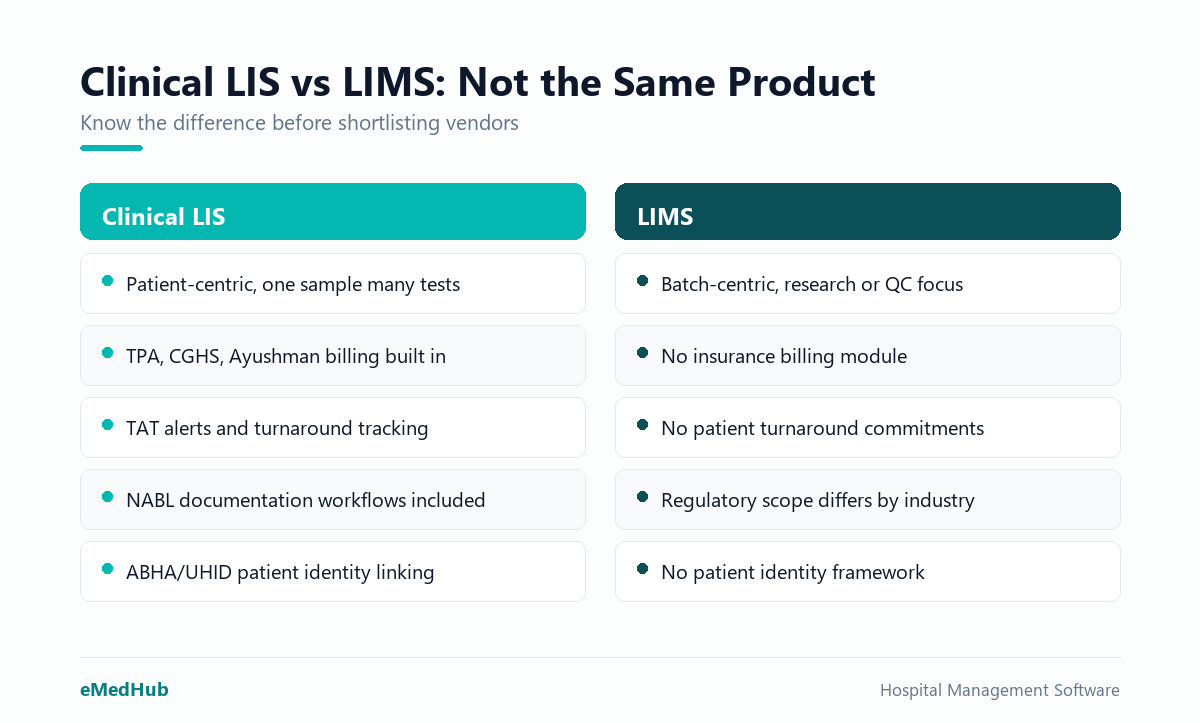
A true LIS differs from a LIMS (Laboratory Information Management System), which is built for research environments and batch processing. Your clinical diagnostic lab needs a system designed for patient-centric workflows: one sample, many tests, tight turnaround time commitments, and downstream billing. An LIS is also distinct from a Hospital Information System (HIS), which manages the whole hospital. The LIS either sits within the HIS or connects to it via an interface, sharing patient demographics and passing validated results back automatically.
In the Indian context, a credible LIS must handle the regulatory documentation that NABL accreditation demands, support TPA authorisation and CGHS/ESI billing codes, and run reliably on the network connectivity that is actually available in a tier-2 or tier-3 city. Products designed purely for metro markets often stumble on these real-world constraints.
Core Modules Every LIS Software Should Cover
Vendors routinely show you the report output screen and call it a product demo. Ask them to walk through every module below before making any decision. If they skip a section, that usually means it does not exist or is not production-ready.
Sample Management and Barcoding
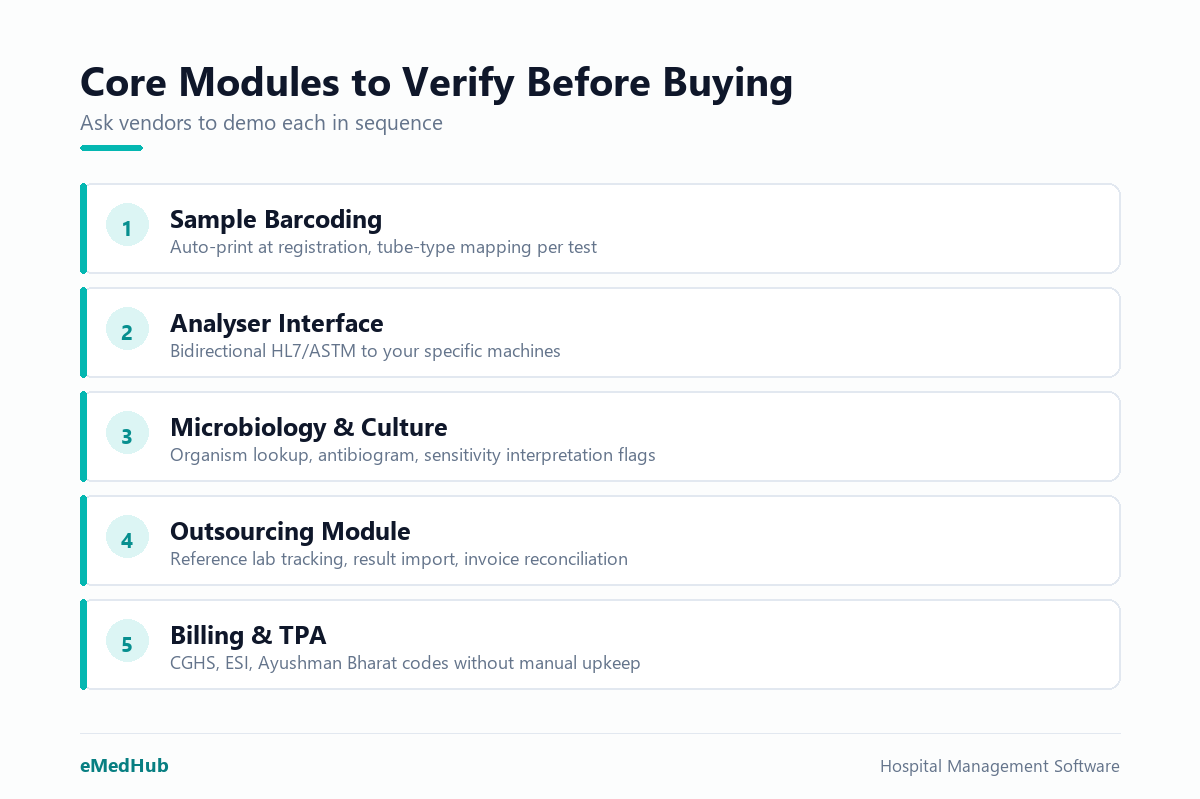
Every sample gets a unique barcode at registration, and that barcode follows the tube through collection, centrifugation, and analysis. Without this, a busy lab processing 400 samples a day cannot guarantee that the right result goes to the right patient. Mis-labelling in a manual lab is not hypothetical; it happens, and it can lead to serious downstream clinical errors.
Analyser Interfacing
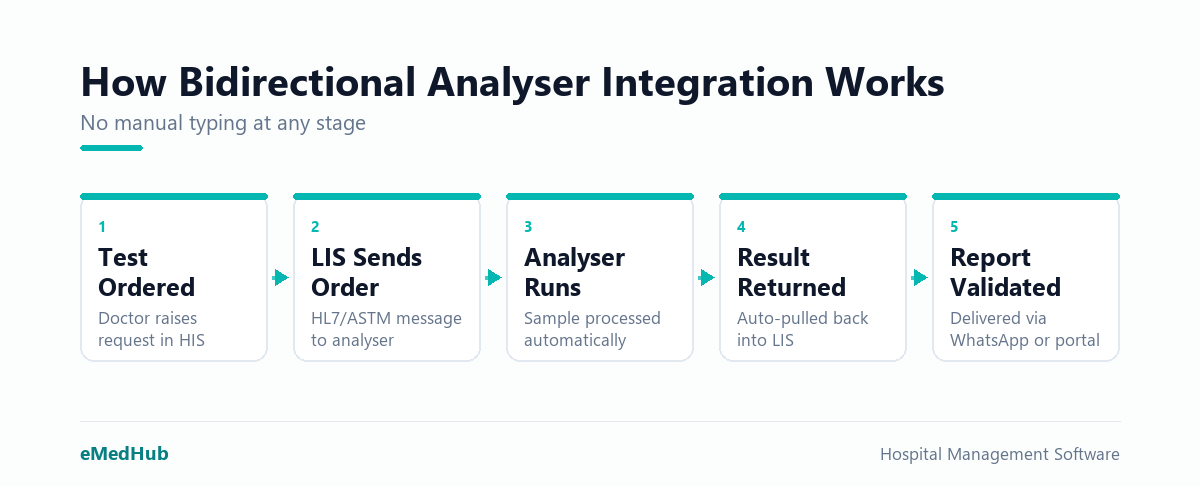
A modern LIS connects directly to your haematology counters, biochemistry analysers, and urine analysers and pulls results automatically. This eliminates manual transcription, the single largest source of clerical error in pathology. Look for bidirectional interfaces: the LIS sends the test order to the machine and receives the result back without any human typing required.
Microbiology and Culture Reporting
Culture reports are not simple numeric results. They require organism identification, antibiotic sensitivity panels, minimum inhibitory concentration values, and often a clinical comment. Many basic LIS products handle haematology and biochemistry adequately but have a weak or absent microbiology module. If your lab does culture work, insist on a dedicated demonstration of this module before buying.
Outsourcing and Reference Lab Management
Most mid-sized labs outsource some tests to reference labs: specialised genetic panels, rare histopathology stains, or send-out cultures. Your LIS should track outsourced samples, record the reference lab's result, and generate the final patient report under your lab's letterhead with a clear indication of the performing lab. It should also reconcile reference lab invoices against what you billed the patient, making revenue leakage from mis-pricing immediately visible.
Inventory and Reagent Management
Reagent costs represent 30 to 40 percent of a diagnostic lab's total operating expense in most Indian setups. A lab that tracks reagent consumption test-by-test can identify kit wastage, calibrator overuse, and near-expiry stock before it becomes a write-off. Good LIS software links test volume to reagent consumption and raises alerts when stock falls below the reorder threshold.
Billing, TPA, and Insurance Integration
For hospital-attached labs, billing must integrate with the main HIS so that charges post automatically when tests are ordered. For standalone diagnostic centres, your diagnostic lab management software should support CGHS rate lists, ESI billing, Ayushman Bharat package codes, and state health scheme tariffs without requiring manual price-list maintenance on each terminal.
| LIS Module | What to Verify in the Demo | Red Flag if Missing |
|---|---|---|
| Sample registration and barcoding | Auto-barcode print at registration, tube-type mapping per test | Manual sample numbering |
| Analyser interface | Bidirectional HL7 or ASTM connection to your specific machines | One-way or manual result entry only |
| Microbiology and culture | Organism lookup, antibiogram panel, sensitivity interpretation flags | Free-text comment field only |
| Outsourcing module | Reference lab tracking, result import, invoice reconciliation | No tracking once the sample leaves your lab |
| Inventory | Per-test reagent consumption, expiry alerts, reorder triggers | Manual stock register only |
| Quality control | Levey-Jennings charts, Westgard rules, delta checks | No QC charting; result entry only |
| Report delivery | WhatsApp, email, patient portal, and printed report options | Print-only output |
NABL Compliance: What Your LIS Must Support
NABL accreditation under ISO 15189:2022 is increasingly a prerequisite for hospital empanelment with CGHS, insurance companies, and large corporates. During an assessment, examiners look closely at your quality management documentation and will ask to see evidence directly from your software. A weak LIS forces your team to maintain parallel paper records, which creates audit risk and undermines the entire accreditation exercise.
Your LIS must support the following for NABL readiness:
- Full audit trail: Every result modification must log who changed what, when, and why. Assessors will ask you to pull this report on the day of the assessment.
- Delta checks: Automatic flagging when a patient's current result deviates significantly from their previous result catches both clinically significant changes and clerical entry errors before the report is released.
- Internal quality control: Levey-Jennings charting for control materials, with Westgard rule violations flagged before results are released to clinicians.
- External quality assurance: A module to log your EQA or EQAS participation results and record corrective actions taken in response to performance failures.
- Turnaround time monitoring: TAT tracking from sample receipt to result dispatch, with configurable breach alerts by test category and urgency level.
- Document management: SOPs, calibration records, and equipment maintenance logs linked to the relevant test or analyser within the system, not stored in a folder on someone's desktop.
Labs that manually maintain this documentation alongside a basic billing-only LIS typically spend 8 to 12 staff-hours a week on paperwork that good software would generate automatically. At a salary cost of ₹25,000 to ₹35,000 a month for a lab technician, that overhead amounts to roughly ₹2 to ₹3 lakh a year in unproductive effort, before accounting for the risk of a failed or deferred assessment.
Analyser Integration and Middleware
Ask every vendor a direct question before you commit: does your LIS have a live, certified, bidirectional interface with the specific make and model of analysers currently installed in my lab? Not whether they support HL7 in general, but whether your exact equipment has been connected and tested in a production deployment elsewhere.
Most mid-range Indian labs run a mix of Mindray, Sysmex, Erba, Roche, or Abbott machines. Each brand uses variants of HL7 or ASTM protocols, but implementation details vary across models. A middleware layer sits between the analysers and the LIS when a direct interface is not available. Middleware is a legitimate solution, but it adds a hardware cost of roughly ₹50,000 to ₹1.5 lakh per connection point and an additional dependency to maintain and troubleshoot.
The practical test before signing: ask the vendor to run a live end-to-end demo where a test is ordered in the LIS, transmitted to the analyser, the result comes back automatically, and posts to the patient record without anyone typing a number. If they cannot demonstrate this with your analyser model, expect manual entry in production and budget for the associated error rate.
For labs connected to a hospital HIS, the LIS must also interface upward. Test orders placed by the ward or OPD should flow into the LIS automatically, and validated results should post back to the clinical record without a phone call to the lab. This bidirectional HIS-LIS link is a basic requirement for any hospital-attached lab, yet many installations still route requests on printed requisition slips.
How to Choose Lab Management Software for an Indian Lab
Choosing lab management software is a multi-year commitment. The checklist below separates credible vendors from those who over-promise at the sales stage and under-deliver after go-live.
- Reference sites you can call: Ask for three labs of similar size and type that have been live on the system for at least 18 months. Call them directly and ask what broke at go-live and how long support took to respond.
- Implementation ownership: Who specifically handles data migration, barcode label configuration, report template design, and analyser interfacing? Get names and responsibilities in writing before signing anything.
- Support in your city: A vendor headquartered in Bengaluru may have no local presence in Nagpur or Varanasi. After-sales support quality in tier-2 and tier-3 locations is often the real differentiator once the honeymoon period ends.
- NABL audit experience: Has the vendor supported a lab through an actual NABL assessment? Ask to see the pre-assessment checklist they help clients prepare and whether they have done it in your state.
- Scalability and multi-branch licensing: If you open a second collection centre, can you add it without a full re-implementation? Get multi-branch pricing in writing upfront so there are no surprises at expansion.
- ABDM and ABHA integration: The push towards Ayushman Bharat Digital Mission is real. Labs that link results to a patient's ABHA ID gain an advantage in government empanelment. Confirm whether this is live in production or genuinely on the near-term roadmap with a committed date.
- Total cost of ownership: Break down the full annual cost: software licence, implementation, training, annual maintenance charges, and per-message delivery fees for SMS and WhatsApp reports. A ₹3 lakh implementation fee with ₹8 lakh annual AMC is a very different three-year commitment from the headline number on the proposal.
How eMedHub Handles Laboratory Management
eMedHub includes a fully integrated LIS module built for both hospital-attached labs and standalone diagnostic centres. The module covers sample registration with barcode printing, bidirectional analyser interfaces for major Indian equipment brands, a dedicated microbiology module with antibiogram support, reagent inventory tracking linked to test consumption, and a structured outsourcing workflow for reference lab samples.
NABL documentation requirements including delta checks, Levey-Jennings QC charting, TAT monitoring, and full audit trails are built into the core product. For hospital users, lab orders from OPD and IPD flow directly into the LIS, and validated results post back to the clinical record automatically. The billing module handles CGHS, ESI, Ayushman Bharat, and commercial TPA tariffs from a single configuration screen.
Explore the full feature set on the diagnostic lab management software page or review the detailed capability list on the laboratory management product page. To see your specific analyser interfaced live, book a demo with the eMedHub team.
Frequently asked questions
What is the difference between a LIS and a LIMS?
An LIS (Laboratory Information System) is designed for clinical diagnostic labs managing patient samples, test workflows, and billing. A LIMS is designed for research and industrial environments managing batch experiments. If you run a hospital pathology or diagnostic lab, you need an LIS. The two systems have fundamentally different workflow assumptions and should not be treated as interchangeable when evaluating software.
How much does LIS software cost in India?
LIS implementation in India typically costs ₹2 lakh to ₹15 lakh depending on lab size, number of analyser interfaces, and modules required. Annual maintenance charges range from ₹1 to ₹5 lakh. Cloud-based subscription models may charge ₹5,000 to ₹20,000 a month. Always calculate the three-year total cost of ownership, including AMC and per-message delivery charges, not just the upfront licence fee.
Is analyser integration mandatory in a laboratory information system?
For labs processing more than 100 samples a day, yes. Manual transcription of analyser results is the primary source of clerical error in pathology. Bidirectional analyser integration eliminates transcription, reduces turnaround time, and is reviewed closely during NABL assessments. Below 50 samples a day, careful manual verification is workable but still carries meaningful risk of transcription errors.
Can a standalone diagnostic lab use the same LIS as a hospital lab?
Yes, but the configuration requirements differ. A standalone lab needs strong collection centre management, reference lab outsourcing, direct patient billing, and WhatsApp or email report delivery. A hospital lab needs deep integration with the ward and OPD modules. Good LIS products handle both contexts, but confirm which mode the vendor has deployed more often before you commit to a platform.
What does NABL require from laboratory software?
NABL under ISO 15189:2022 requires your software to maintain a full audit trail of result modifications, support Levey-Jennings QC charting with Westgard rule violation flags, record delta check alerts, track sample turnaround times by test category, and store equipment calibration and maintenance logs. Assessors will ask to generate these reports directly from your system during the technical assessment visit.