A medico-legal case lands in your emergency at midnight. The constable is waiting. Your duty doctor is managing two critical patients simultaneously. In that pressure, one missed field or one unsigned entry can turn a routine report into a courtroom problem. Getting mlc documentation hospital-wide right the first time is not a paperwork formality. It is an institutional and legal obligation that every treating doctor, nursing supervisor, and ward coordinator must understand before the next case arrives.
What is MLC documentation? MLC documentation is the structured clinical record for any patient case with potential legal implications. A complete medico-legal case report must capture patient identity, time of arrival, informer name and relationship, injury description with probable age, police station name, AR or IR number, and the treating doctor's dated signature. All entries must be contemporaneous, written at the time of examination, never reconstructed afterward.
What Is an MLC?
A medico-legal case is any patient encounter where clinical findings may carry legal consequences. The category covers injuries from road traffic accidents, assault, poisoning whether accidental or deliberate, burns, sexual offences, unknown-cause unconsciousness, and deaths or near-deaths under suspicious circumstances. The moment your ER registers a case as an MLC, the treating doctor becomes a potential legal witness and the clinical record becomes admissible evidence in court or an official inquiry.
The obligation to register is not discretionary. Under the Bharatiya Nyaya Sanhita, which replaced the Indian Penal Code, failing to report a cognisable offence is itself an offence. Your emergency team cannot wait for a senior doctor's approval before beginning documentation. Any registered medical practitioner on duty has the authority and the duty to register the case immediately.
Required Fields in an MLC Report
An incomplete mlc report is worse than a late one. Courts and defence lawyers look for gaps. Every field below is mandatory. If information is genuinely unavailable, record why it is unavailable rather than leaving the field blank.
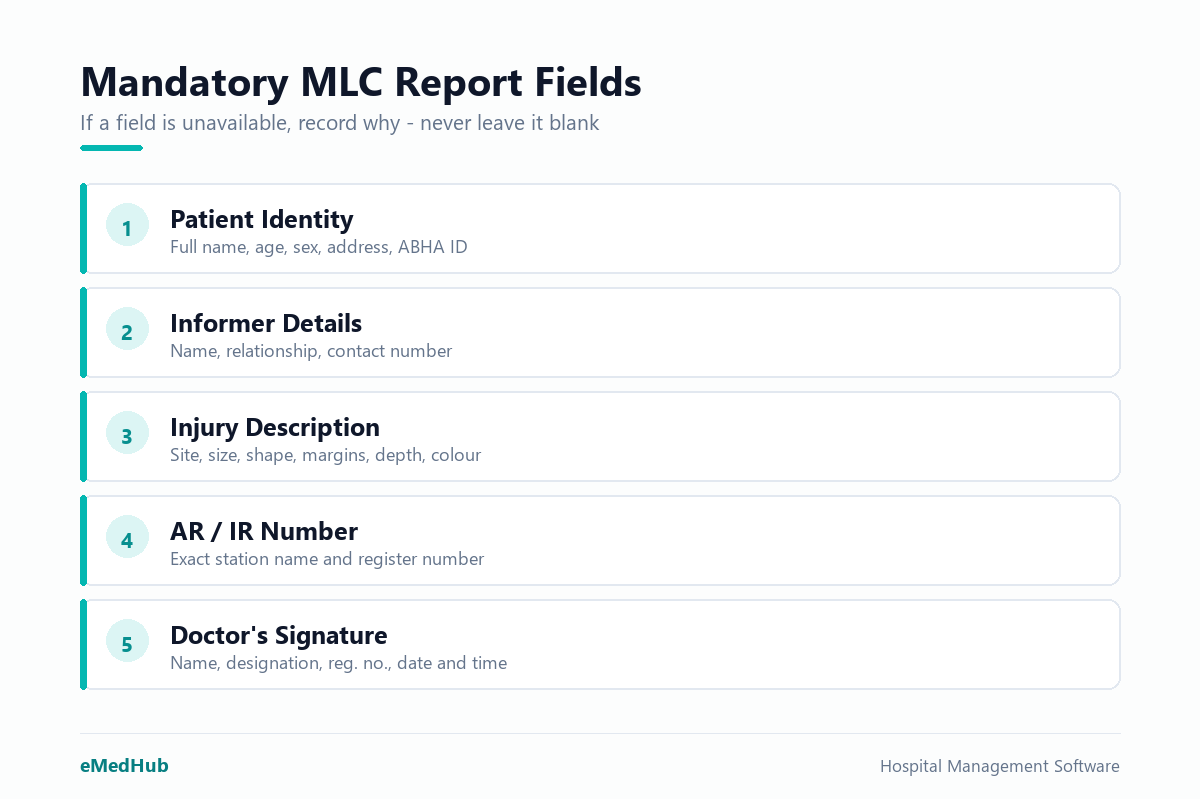
| Field | What to Record | Common Error |
|---|---|---|
| Patient identity | Full name, age, sex, address, ABHA ID if available | Recording only the name on the referral slip |
| Informer details | Name, relationship to patient, contact number | Writing relative with no name or number |
| Time of arrival | Date and time in 24-hour format | Leaving time blank and filling it later |
| Injury description | Site, size, shape, margins, depth, colour, foreign body | Writing multiple abrasions with no measurements |
| Probable age of injury | Fresh, recent, or old, with clinical reasoning | Omitting injury age entirely |
| Police station and AR/IR number | Exact station name, Accidental Register or Injury Report number | Leaving it blank until the constable arrives |
| Doctor's signature | Full name, designation, registration number, date and time | Illegible signature with no printed name below |
Two fields deserve extra attention. The informer is the person who brought the patient or reported the incident. Record their details even when the patient is conscious and can speak for themselves. Courts have overturned witness testimony when the informer could not be traced because the hospital wrote only patient himself with no contact number.
The AR number (Accidental Register) or IR number (Injury Report) is assigned by the police station. Call the local station, convey the case details, and record the number given. Do not wait for police to visit your facility first.
Capturing MLCs in the Emergency Room
The emergency room is where MLC documentation either succeeds or fails. Staff are busy, systems are noisy, and the instinct is to treat first and document later. That instinct creates defensible gaps. Your ER workflow needs a built-in checkpoint that prevents the patient from moving to a ward or OT until the MLC form is at least partially completed.
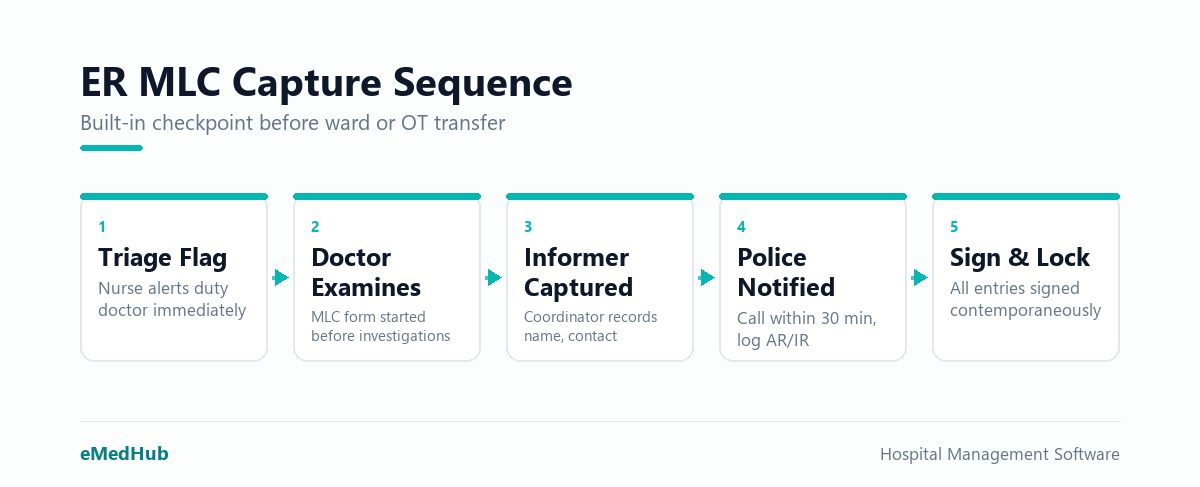
Recommended ER capture steps, in order:
- Triage nurse flags the case as a potential MLC at registration and alerts the duty doctor immediately.
- Duty doctor examines the patient and begins the MLC form before ordering investigations, recording the time of examination separately from the time of arrival.
- Informer details are captured by a ward coordinator while the doctor examines the patient.
- The nurse supervisor calls the local police station, conveys the case, and notes the AR or IR number in the MLC register and in the electronic record.
- A photograph of visible injuries is taken with patient or informer consent noted in writing, and the image is attached to the record.
- All entries are signed contemporaneously. No retrospective additions are permitted without a dated correction note co-signed by a supervisor.
Hospitals using eMedHub's inpatient management module can configure a mandatory MLC checklist that locks the ER admission unless every required field is completed. That single configuration eliminates the most common documentation gap: the blank field discovered during a court query six months later.
Reporting the Medico-Legal Case to Police
Indian law requires immediate reporting of cognisable offences to the nearest police station. In practice, this means a phone call within the first 30 minutes of registering the case as an MLC, not after shift handover. Record the following in your MLC register each time:
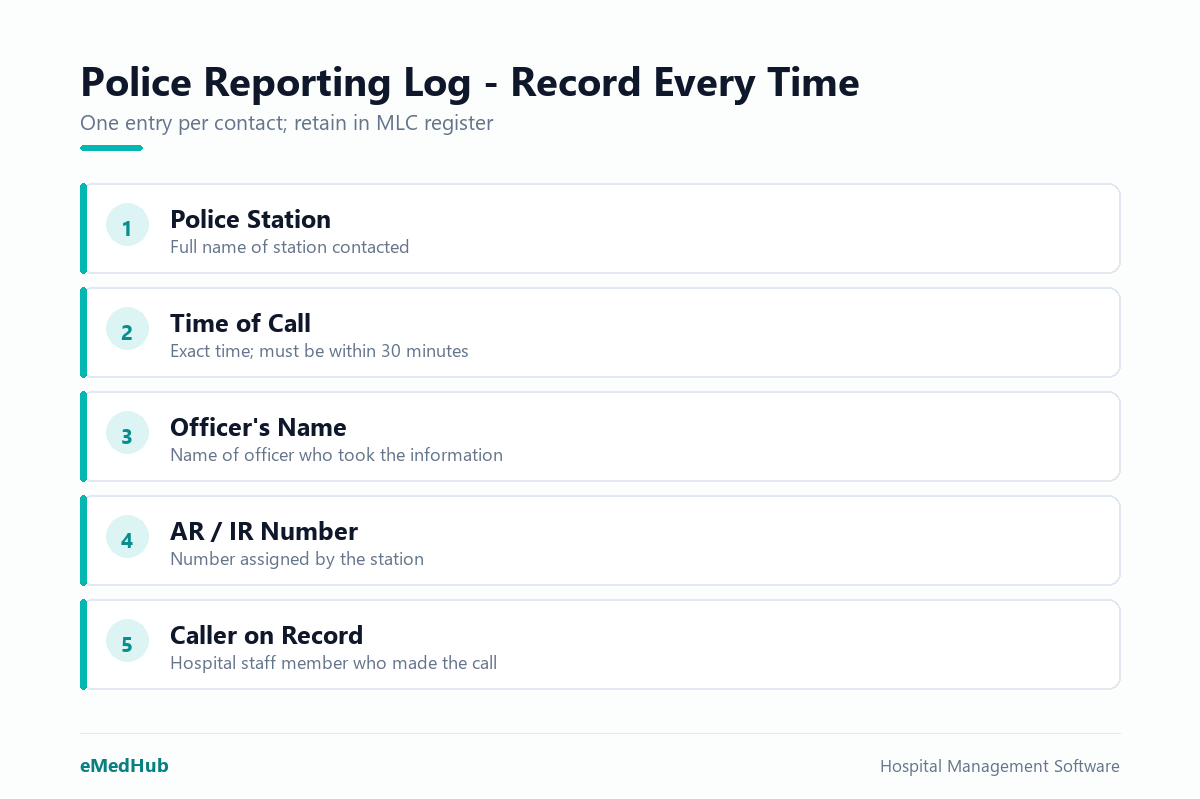
- Name of police station contacted
- Time of call
- Name of the officer who received the information
- AR or IR number provided
- Name of the hospital staff member who made the call
When police arrive for a statement, the treating doctor should be present or immediately reachable. Do not allow nursing staff to answer clinical questions on the doctor's behalf. The doctor's written statement must be read carefully before signing. Any opinion on cause of injury, probable weapon, or time since injury is a clinical opinion and must be worded with precision.
For sexual offence cases, the protocol differs. The patient's written consent for examination is mandatory before recording any clinical findings. A female doctor must conduct the examination wherever possible. These requirements apply regardless of whether your hospital is NABH-accredited, but NABH auditors will check your documented compliance against the relevant criteria.
Audit and Retention of MLC Records
MLC records carry longer retention obligations than routine clinical files. While most states mandate a minimum of five years for general records, medico-legal case files should be retained for at least ten years, given that criminal and civil proceedings can continue long after the original incident.
Run an internal MLC audit every month. Your checklist should cover:
- All required fields completed, with no blanks and no unexplained entries
- AR or IR number recorded for every registered case
- Informer name and contact number present
- Time of examination recorded separately from time of arrival
- Doctor's signature with printed name, designation, and registration number
- Police reporting time noted
- Consent documented for sexual offence examinations
- Photographs or diagrams attached where relevant
Every quarter, cross-check your MLC register against emergency admission logs to confirm no case was treated without registration. A medico-legal case that was treated but not registered is not a saved record. It is an unrecorded liability. If your hospital is preparing for NABH accreditation, expect auditors to pull a random sample of MLC files and review each field. Gaps will cost you criteria points.
How eMedHub Handles MLC Documentation
eMedHub builds MLC compliance into the emergency admission workflow rather than treating it as an afterthought. The system presents a structured MLC form at triage, flags incomplete fields before the record can be saved, and logs the AR or IR number against the patient's clinical record. Every entry carries an automatic timestamp and user ID, so the audit trail is built from the first keystroke.
The inpatient management module links the MLC record to the patient's full IP episode, meaning the medico-legal file, lab reports, imaging, and discharge summary stay connected under one encounter number. When a court order or police request arrives, your team can produce a complete, timestamped dossier in minutes rather than searching through paper files.
Book a demo to see how eMedHub can reduce MLC documentation gaps at your hospital.
Frequently asked questions
What information must be recorded in an MLC report in India?
A complete MLC report must include the patient's full identity, time of arrival, informer name and contact number, injury description with site and dimensions, probable age of injuries, name and AR or IR number of the police station contacted, and the treating doctor's signature with designation and registration number. Leaving any field blank without explanation creates a legal vulnerability.
Who is responsible for registering an MLC case in a hospital?
Any registered medical practitioner on duty has the authority and the responsibility to register an MLC. You cannot delegate this to a nurse or ward staff. The duty doctor must examine the patient, record findings, and initiate police notification within 30 minutes of identifying the case as medico-legal.
How long should MLC records be retained by a hospital?
Most Indian states require a minimum five-year retention for general clinical records, but MLC files should be kept for at least ten years. Criminal and civil cases tied to an MLC can take years to reach trial or appeal, and your original documentation may be summoned at any point during that period.
What is the difference between an AR number and an IR number in MLC cases?
An AR number (Accidental Register number) is issued by the police station for accident-related cases. An IR number (Injury Report number) applies to assault and other non-accidental injuries. Both are assigned by the local station when your hospital calls to report the case. Record whichever is issued, along with the officer's name and the time of the call.
Can a hospital face legal consequences for not registering an MLC?
Yes. Under Indian law, failure to report a cognisable offence is itself an offence. A hospital that treats an MLC patient without registering the case or notifying police exposes the treating doctor, the medical superintendent, and the institution to criminal liability and possible loss of NABH accreditation.