Every Indian hospital owner eventually faces the NABH question. You want accreditation for credibility, for TPA and Ayushman Bharat empanelment, and to give your staff a quality framework they can actually use. But which level do you aim for first? The choice between entry level NABH vs full NABH is not just a paperwork decision; it shapes your timeline, budget and clinical operations for the next two to three years.
Direct answer: Entry-level NABH covers a focused subset of standards aimed at smaller hospitals beginning their quality journey. Full NABH requires compliance across all standards in every department. Entry-level suits hospitals under 50 beds or new to accreditation; full NABH suits larger, TPA-dependent facilities ready for a comprehensive audit and prepared to commit significant time and budget.
The Two Paths in NABH Certification
NABH (National Accreditation Board for Hospitals & Healthcare Providers) offers two distinct NABH certification levels. The Entry-Level programme, formally called Pre-Accreditation Entry Level (PAEL), was designed for hospitals with fewer than 50 beds that want a structured first step into quality improvement. Full NABH is the comprehensive programme assessed against every applicable standard and intent, covering all departments from OPD to OT to pharmacy.
The core distinction is scope. Entry-level evaluates a curated set of standards across patient care, infection control, nursing, support services and management. Full NABH adds clinical audit requirements, outcome tracking, adverse event reporting and continuous quality improvement committees. If your hospital currently runs on experience and informal protocols rather than documented SOPs, entry-level is the realistic, honest starting point. Learn more about the programme structure on our NABH accreditation overview.
What Each Level Requires
Understanding the concrete requirements for both levels helps you plan accurately rather than discover gaps mid-preparation. The table below sets out the key differences at a glance.
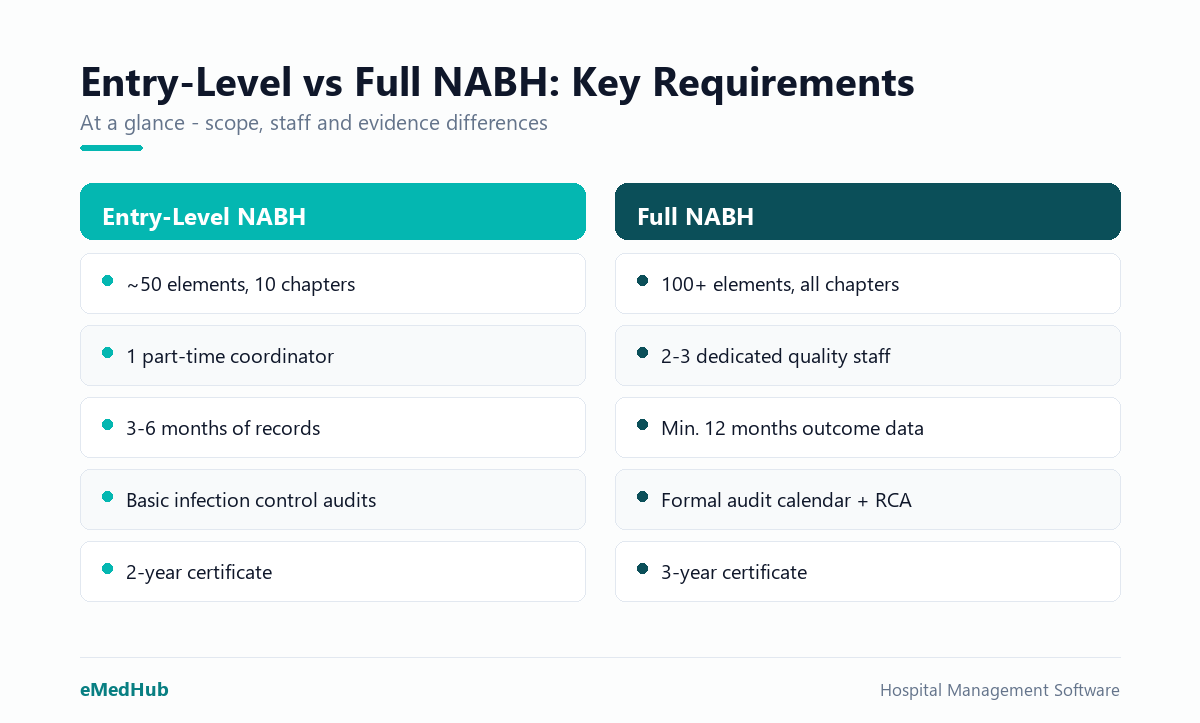
| Requirement | Entry-Level NABH | Full NABH |
|---|---|---|
| Standards assessed | ~50 measurable elements, ~10 chapters | 100+ elements across all chapters |
| Quality staff needed | One focal point, part-time acceptable | Two to three dedicated quality staff |
| Evidence records | 3–6 months of documentation | Minimum 12 months of outcome data |
| Clinical audits | Basic infection control audits | Formal audit calendar, root-cause analysis |
| Doctor credentialing | Basic registration verification | Full credentialing and privileging for all consultants |
| TPA billing documentation | Helpful but not mandatory | Mandatory, assessed in detail |
| Certificate validity | 2 years | 3 years |
Entry-level NABH asks for documented policies on patient rights, medication management, infection prevention and basic fire safety. A part-time quality coordinator can manage the process for a 30–50 bed hospital. Full NABH requires a functioning quality committee, monthly outcome dashboards and root-cause analysis for every adverse event. That means structured reporting built into daily operations, not assembled the week before assessors arrive.
Cost and Effort Compared
Application fees are only the visible tip of the cost. Internal preparation: staff time, training, SOP writing, software and often an external consultant, is usually the larger investment. Here is a realistic breakdown for a hospital in a tier-2 city:
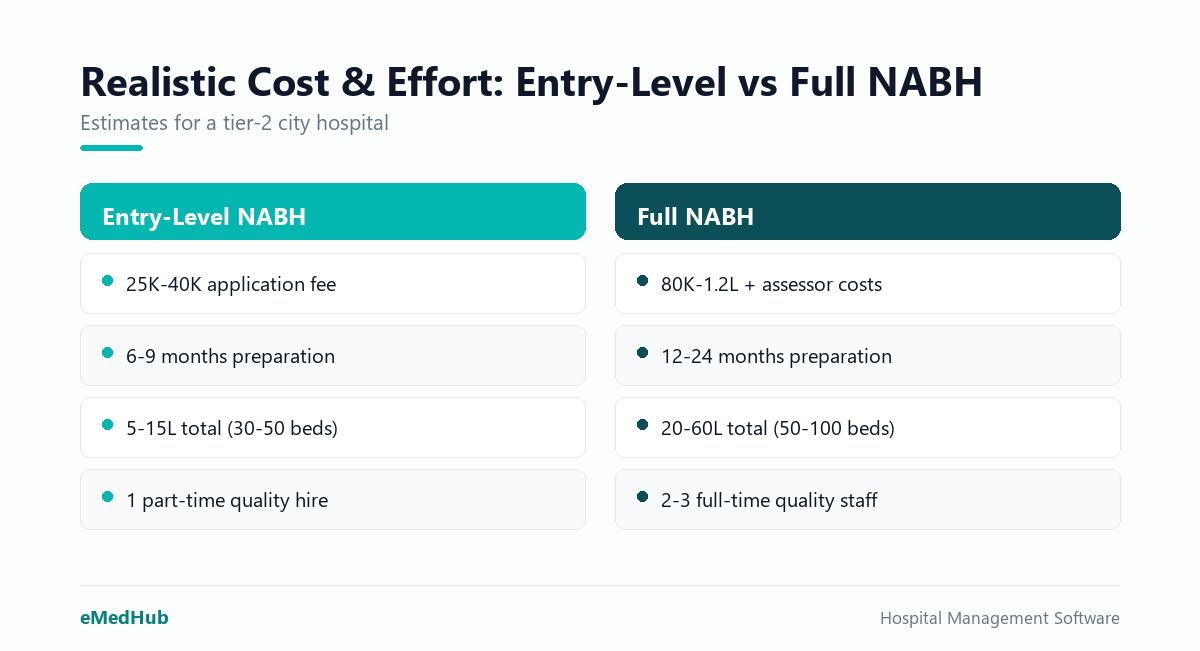
- Entry-level application fee: ₹25,000 to ₹40,000, depending on bed strength and state.
- Full NABH application fee: ₹80,000 to ₹1,20,000 for a 50-bed hospital, plus assessor travel and accommodation reimbursement.
- Internal preparation, entry-level: 6 to 9 months, one coordinator, nursing and housekeeping training. Total internal cost typically ₹5 to ₹15 lakh for a 30–50 bed hospital.
- Internal preparation, full NABH from scratch: 12 to 24 months, two to three quality staff, department-by-department SOP writing and clinical audit tools. Total internal cost typically ₹20 to ₹60 lakh for a 50–100 bed hospital.
Consider a 40-bed hospital in Nagpur billing ₹80 lakh a month. If it attempts full NABH without any existing quality infrastructure, it could spend 18 months in preparation, pull a senior nurse into full-time quality work, and still fail the first assessment because 12 months of outcome data simply does not exist yet. The same hospital going through entry-level first builds the data trail, the SOPs and the staff habits that make full NABH achievable in the next cycle. That is a practical saving of six to twelve months and ₹10 to ₹20 lakh in avoidable consultant and staff costs.
Entry Level NABH vs Full: Which Fits Your Hospital?
Use this decision framework honestly. If three or more points apply to you in a column, that path is the right starting point for your current situation.
Choose Entry-Level NABH if your hospital:
- Has fewer than 50 beds, or is a standalone diagnostic lab, IVF clinic or eye-care centre.
- Has no existing quality documentation: no SOPs, no incident registers, no infection control audit forms in routine use.
- Earns primarily from OPD cash, local corporate panels or retail pharmacy, with CGHS or Ayushman Bharat below 20% of total revenue.
- Can spare one person for roughly half their working week on quality activities, but cannot justify a full-time quality hire yet.
- Wants to achieve accreditation within 12 months.
Choose Full NABH if your hospital:
- Has 75 beds or more, with established nursing ratios and a functional medical records department.
- Earns more than 30% of revenue from TPA billing: CGHS, ESI, Ayushman Bharat, or state schemes such as Mahatma Jyotiba Phule Jan Arogya Yojana or Aarogyasri.
- Has already completed entry-level NABH or an equivalent structured internal quality programme.
- Can staff a quality department with two dedicated people and support them with a quality committee that meets monthly.
- Has at least 12 months of documented clinical outcomes, infection control data and adverse event records.
Not sure which column describes you? The NABH readiness assessment tool gives you a structured gap analysis in under 10 minutes, before you commit budget to either path.
The Upgrade Path from Entry-Level to Full NABH
Entry-level NABH is not a consolation prize. It is the first step on a defined ladder. NABH expects hospitals certified at entry level to progress toward full accreditation, and the two-year certificate validity is designed with that progression in mind. In practice, well-prepared hospitals move to full NABH within two to three years of their first certificate.
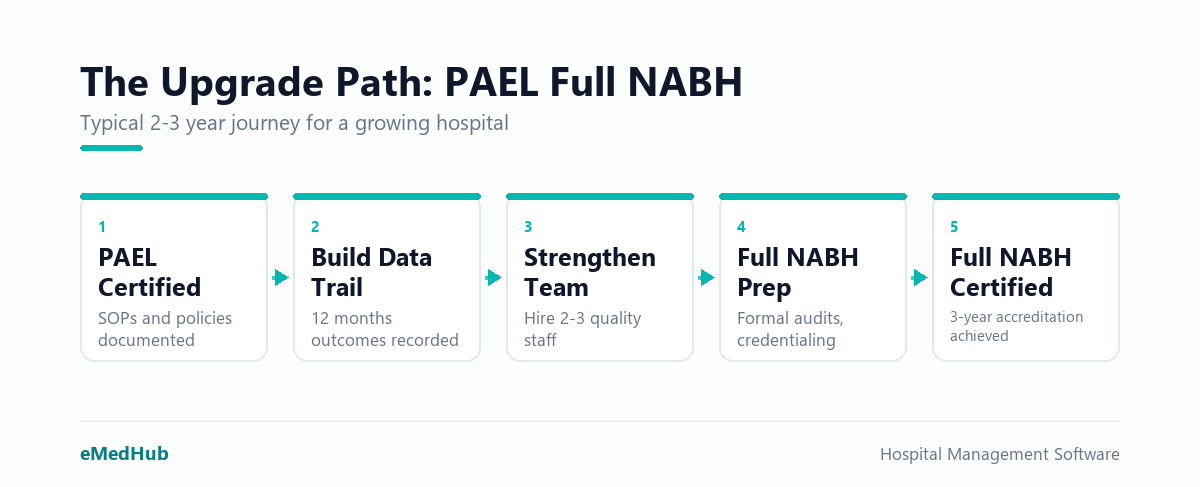
The upgrade works because entry-level preparation builds exactly what full NABH later demands. Your infection control nurse learns to keep monthly audit records. Your pharmacy team starts documenting near-misses and adverse drug reactions. Your billing staff aligns discharge summaries with TPA claim formats. When you begin full NABH preparation, you are refining a running system rather than building from zero. That cuts preparation time roughly in half and significantly reduces dependence on external consultants.
Plan the upgrade from day one. During entry-level preparation, set up your quality committee even if it meets only quarterly. Start a clinical audit calendar even if it covers just two indicators initially. When your entry-level certificate arrives, you will already be several months into the groundwork for full NABH, and the transition will feel like a continuation rather than a restart.
How eMedHub Supports Your NABH Journey
eMedHub is built with both NABH certification levels in mind. The system maintains audit-ready records automatically: discharge summaries, medication error logs, infection control checklists, nursing assessments and consent forms are stored against each patient encounter and retrievable by assessors without manual collation. For hospitals on the entry level NABH track, the built-in quality module covers documentation requirements from day one. For hospitals preparing for full NABH, the outcome dashboard tracks indicators month by month so you are never scrambling for data when assessors arrive. ABDM/ABHA integration keeps your records aligned with national digital health standards alongside NABH requirements.
See the full standards mapping on our NABH accreditation overview, or book a 30-minute demo to walk through the quality module with your own hospital workflow in mind.
Frequently asked questions
What is the difference between entry-level NABH and full NABH accreditation?
Entry-level NABH (PAEL) assesses around 50 measurable elements across 10 chapters and suits hospitals under 50 beds beginning their quality journey. Full NABH covers all standards across every department, requires at least 12 months of outcome data, dedicated quality staff and a formal clinical audit programme. Entry-level certificates are valid for 2 years; full NABH for 3 years.
Can a 30-bed hospital apply for full NABH accreditation directly?
Yes, there is no rule barring a smaller hospital from applying for full NABH. But without existing SOPs, quality staff and outcome data, the preparation burden is disproportionate to the benefit. Most 30-bed hospitals find entry-level NABH a more practical first step, building the documentation foundation that makes full accreditation achievable in the next cycle.
How long does entry-level NABH preparation typically take?
For a hospital starting from scratch, typically 6 to 9 months. This covers gap analysis, SOP writing, staff training across nursing and housekeeping, infection control audit implementation, and the NABH desktop review followed by the on-site assessment. Hospitals that already have some documentation in place can often compress preparation to 4 to 6 months.
Does entry-level NABH certification help with Ayushman Bharat or CGHS empanelment?
Entry-level NABH is a recognised quality credential and may support empanelment applications with state Ayushman Bharat schemes and CGHS panels, though criteria vary by state and payer. Several state schemes explicitly list NABH-accredited hospitals for higher package rates. Always verify the specific empanelment criteria for your state scheme before relying on this as your primary reason to pursue accreditation.
How much does full NABH accreditation cost for a 50-bed hospital in India?
Application fees run ₹80,000 to ₹1,20,000 for a 50-bed hospital, plus assessor travel reimbursement. Internal preparation typically adds ₹20 to ₹60 lakh over 12 to 24 months, covering quality staff salaries, consultant fees, SOP development and software. Completing entry-level NABH first reduces this total by cutting preparation time and external consultant dependency in the full accreditation cycle.