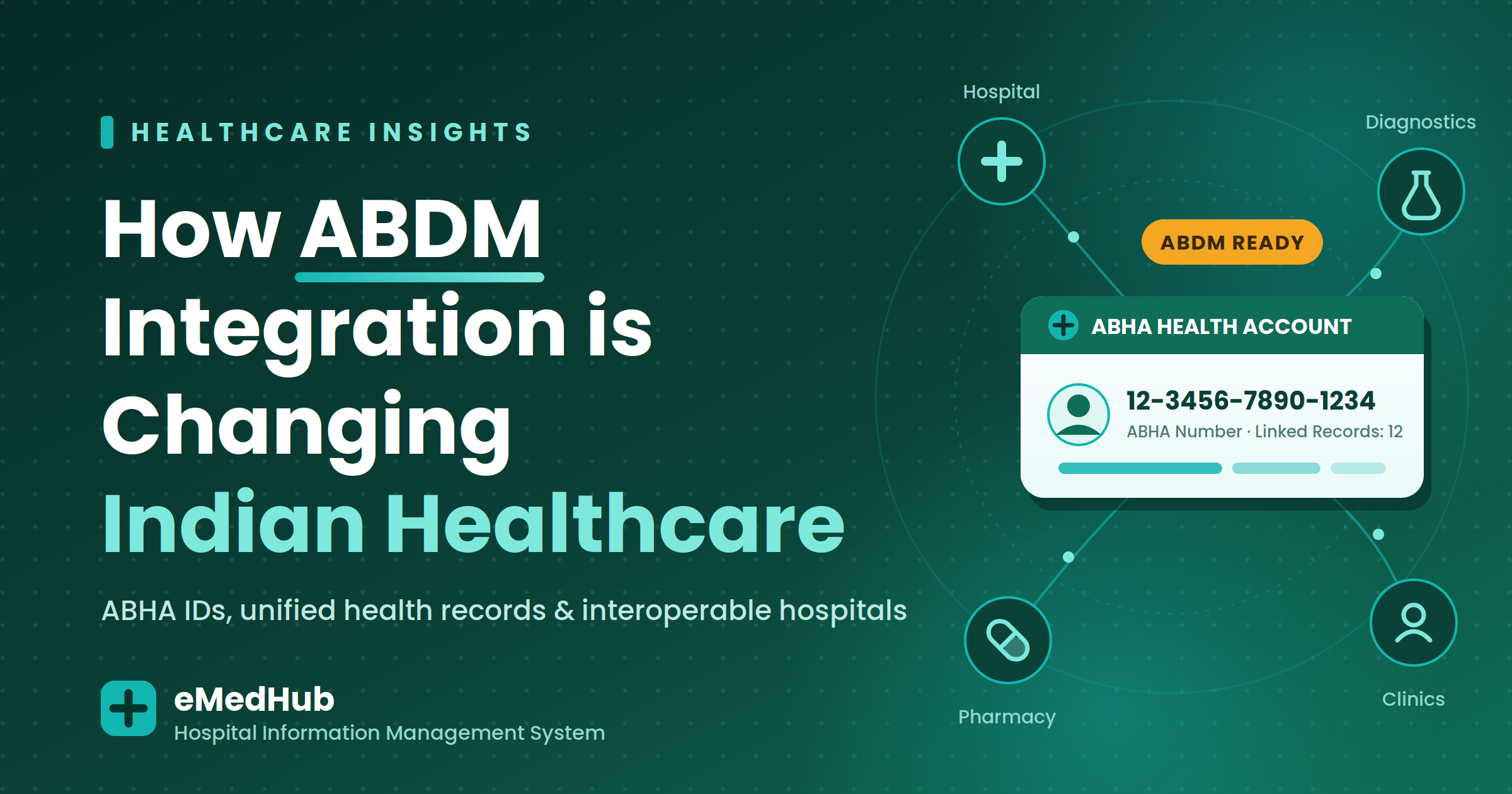
The Ayushman Bharat Digital Mission (ABDM) represents one of the most ambitious digital health initiatives in the world. Launched by the Government of India, ABDM aims to create a unified digital health ecosystem that connects patients, healthcare providers, and payers through a shared infrastructure. For hospitals across India, this is not just a regulatory checkbox — it is a fundamental shift in how healthcare data is created, stored, and exchanged.
As of early 2026, over 550 million ABHA numbers have been created, and more than 45,000 health facilities have registered on the Health Facility Registry. The National Health Authority (NHA) has been steadily tightening integration requirements, and state governments are beginning to mandate ABDM compliance for empanelment under public insurance schemes. Understanding what ABDM entails, how its architecture works, and what it means for your hospital's operations is no longer optional knowledge — it is essential for every hospital administrator and IT decision-maker in India.
What is ABDM and Why Does It Matter?
At its core, ABDM provides three foundational building blocks: the Ayushman Bharat Health Account (ABHA) for unique patient identification, the Health Information Exchange and Consent Manager (HIE-CM) for secure data sharing, and the Health Professional Registry for verified provider identities. Together, these components enable seamless interoperability between disparate hospital systems, diagnostic labs, pharmacies, and insurance providers.
The significance of ABDM extends beyond digitization. India's healthcare system has long suffered from fragmentation — a patient visiting three different hospitals accumulates three separate medical records with no linkage between them. Diagnostic reports get lost, medication histories are incomplete, and doctors make decisions without full clinical context. ABDM addresses this structural problem by creating a consent-based digital health data highway that allows information to flow securely between providers, with the patient in control.
How ABDM Architecture Works
ABDM's architecture is built on a federated model, meaning health data stays with the provider who generated it and is shared only upon patient consent. This is fundamentally different from a centralized repository model, and it addresses the primary concern hospitals have about data sovereignty. Understanding the three key registries is essential for any hospital planning integration.
ABHA (Ayushman Bharat Health Account) serves as the universal patient identifier across India's health ecosystem. Each patient receives a 14-digit ABHA number linked to their Aadhaar or mobile number. When a patient visits any ABDM-linked facility, their ABHA number is used to pull or push health records from previous encounters — eliminating the need for patients to carry physical files or repeat their medical history. Hospitals that assign ABHA numbers at registration instantly reduce duplicate records and improve data continuity.
HIE-CM (Health Information Exchange and Consent Manager) is the middleware layer that handles the actual data exchange. When Hospital A needs to access a patient's records from Hospital B, the HIE-CM sends a consent request to the patient. Upon approval, it facilitates the encrypted transfer of FHIR-compliant health records. The HIE-CM maintains a complete audit trail of every consent granted, data request made, and record shared. For hospitals, this means investing in FHIR-capable systems is a prerequisite for meaningful ABDM participation.
HPR (Health Professional Registry) and HFR (Health Facility Registry) complete the trust framework. HPR verifies that every doctor, nurse, and allied health professional is who they claim to be, using data from the National Medical Commission and state medical councils. HFR does the same for facilities. Together, they ensure that health data is exchanged only between verified providers and facilities, preventing unauthorized access and maintaining the integrity of the health data ecosystem.
Key Benefits for Hospitals
· Elimination of duplicate patient records across facilities through ABHA-based identification
· Faster insurance claim processing with digitally verifiable health records
· Reduced paperwork and manual data entry for front-desk staff
· Enhanced patient trust through transparent consent-based data sharing
· Compliance readiness for upcoming government mandates on digital health records
· Interoperability with other ABDM-linked hospitals and diagnostic centres
· Access to a patient's longitudinal health record from previous facilities, improving clinical decision-making
· Streamlined referral workflows between primary, secondary, and tertiary care providers
· Digital verification of doctor credentials, reducing onboarding paperwork for new staff
Step-by-Step ABHA Creation in Hospitals
The ABHA creation workflow is the most visible touchpoint of ABDM for hospital staff and patients. Getting this process right at the registration desk is critical for adoption. Hospitals typically encounter two scenarios: patients who already have an ABHA number and need it linked to the facility, and patients who need a new ABHA created during their first visit.
For new ABHA creation, the front-desk staff initiates the process through the HIMS registration screen. The patient provides either their Aadhaar number or mobile number. If using Aadhaar, an OTP is sent to the registered mobile number for verification. Once verified, the system generates a 14-digit ABHA number and optionally an ABHA address (a user-friendly handle like patient@abdm). The entire process takes 60 to 90 seconds when the HIMS has a well-designed ABDM integration.
For existing ABHA holders, the workflow is even simpler. The patient shares their ABHA number or scans a QR code, the system verifies their identity through OTP, and their ABHA is linked to the facility's records. From this point forward, every clinical encounter at the facility is associated with the patient's ABHA, making their records discoverable by other ABDM-linked providers when consent is given.
Common challenges hospitals face during ABHA creation include patients without Aadhaar linkage to their mobile number, elderly patients unfamiliar with OTP-based verification, and network connectivity issues during peak registration hours. Training front-desk staff to handle these edge cases gracefully — including the option to create ABHA via demographic authentication as a fallback — is essential for smooth adoption.
Implementation Challenges to Prepare For
While the benefits are compelling, hospitals must navigate several practical challenges. Legacy systems often lack FHIR-compliant APIs needed for ABDM integration. Staff training is essential — front-desk personnel must understand ABHA creation and linking workflows. Data migration from paper or older EHR systems requires careful planning to ensure completeness and accuracy. Most importantly, hospitals need a HIMS vendor that has already achieved ABDM certification and can handle the ongoing compliance updates.
Beyond technical readiness, organizational change management is a significant hurdle. Doctors may resist structured data entry requirements that ABDM compliance demands. Billing teams must adapt to digital health record sharing that makes their documentation visible to insurers. IT teams need to manage the ongoing API versioning and compliance updates that NHA releases on a quarterly cycle. A phased implementation plan, starting with registration-level ABHA integration before moving to clinical data sharing, helps manage this complexity.
ABDM Compliance Timeline for Indian Hospitals
The NHA has taken a phased approach to ABDM adoption, but the trajectory is clear — full compliance will be mandatory, not voluntary. Understanding the timeline helps hospitals plan their integration roadmap and budget allocation.
As of 2026, ABDM integration is already mandatory for hospitals empanelled under Ayushman Bharat Pradhan Mantri Jan Arogya Yojana (AB-PMJAY). State governments including Karnataka, Tamil Nadu, Maharashtra, and Uttar Pradesh have issued directives requiring ABDM compliance for new hospital registrations and license renewals. The NHA's published roadmap indicates that by 2027, ABDM compliance will be a prerequisite for CGHS, ECHS, and all central government insurance scheme empanelment.
For private hospitals not currently under government schemes, the market dynamics are equally compelling. Major insurance TPAs have begun offering faster claim settlement for ABDM-linked facilities, as digital health records eliminate the need for manual document verification. NABH's latest accreditation standards reference ABDM readiness in the Information Management chapter, signalling that accreditation and ABDM compliance are converging.
· 2024-2025: Voluntary adoption phase with incentives for early integrators
· 2025-2026: Mandatory for AB-PMJAY hospitals and select state government schemes
· 2026-2027: Required for CGHS, ECHS, and railway health scheme empanelment
· 2027-2028: Expected to become a standard requirement for all hospital licensing renewals in major states
· 2028 onwards: Full ecosystem maturity with patient-driven demand for ABDM-linked facilities
How eMedHub Simplifies ABDM Integration
Implementing ABDM integration from scratch is a significant technical undertaking. The FHIR specification alone runs to thousands of pages, and the NHA's sandbox testing requirements demand rigorous API-level compliance. This is where choosing a HIMS vendor with native ABDM integration becomes a strategic advantage rather than just a convenience.
eMedHub's ABDM module is built directly into the registration, clinical documentation, and discharge workflows. ABHA creation and linking happens within the same screen where front-desk staff register patients — there is no separate application or workflow to learn. Clinical documents including discharge summaries, diagnostic reports, and prescriptions are automatically converted to FHIR-compliant formats and made available through the HIE-CM for consent-based sharing.
The platform handles the ongoing compliance burden as well. When NHA releases API updates or adds new document types to the sharing framework, eMedHub pushes these updates through its standard release cycle, ensuring hospitals remain compliant without requiring manual intervention or custom development. For hospital administrators, this translates to predictable compliance costs and zero disruption to daily workflows.
"Hospitals that adopt ABDM early will have a significant competitive advantage. Patients will increasingly choose facilities where their health records follow them seamlessly."
— Dr. R. S. Sharma, Former CEO, National Health Authority
The transition to ABDM is not optional — it is inevitable. Hospitals that begin their digital transformation journey today, with ABDM-ready systems, will be well-positioned for a future where interoperability is the standard, not the exception. The investment in ABDM integration pays dividends not just in regulatory compliance, but in improved patient experience, streamlined referrals, and reduced administrative overhead across every department.
Frequently Asked Questions About ABDM Integration
Is ABDM integration mandatory for private hospitals?
Not yet universally, but it is rapidly becoming so. Currently, hospitals under AB-PMJAY and several state schemes must comply. Private hospitals should prepare now because major TPAs and NABH are increasingly referencing ABDM readiness. eMedHub provides out-of-the-box ABDM compliance, so hospitals can integrate ahead of mandates without significant additional investment.
How long does ABDM integration take for a hospital?
Timeline depends on your current systems. Hospitals already using an ABDM-certified HIMS like eMedHub can activate ABDM features within one to two weeks. Those migrating from legacy systems should plan for eight to twelve weeks, including staff training, sandbox testing, and go-live. The registration-level integration with ABHA is typically the fastest module to deploy.
Does ABDM require hospitals to share all patient data?
No. ABDM operates on a strict consent-based model. Patient data is shared only when the patient explicitly grants consent through the HIE-CM. Hospitals retain full ownership of the data they generate. eMedHub's consent management module makes it easy for staff to explain the process to patients and record consent digitally.
What happens if our hospital's existing software is not ABDM-compliant?
You have two options: request your current vendor to build ABDM integration, which can take six months or more, or migrate to an ABDM-certified HIMS. eMedHub offers a structured migration program that transfers your existing patient data while simultaneously enabling ABDM compliance, typically completing the full transition within ten to fourteen weeks.
What is the cost of ABDM integration for a mid-sized hospital?
Costs vary based on the integration approach. Building custom ABDM integration can cost Rs 15 to 30 lakh in development and testing. Using a pre-certified platform like eMedHub eliminates this development cost entirely — ABDM features are included as part of the standard HIMS subscription, making it significantly more economical for hospitals of all sizes.